
Why I'm Dropping "Real Quick" From My Vocabulary

(And why you might want to, too)
Two little words that have slipped into almost everything I do.
"Real quick."
→ "I need to use the bathroom real quick."
→ "Let me answer this email real quick."
→ "I'm going to squeeze in a quick walk."
→ "I'll refill my water really quick."
→ "I'm just taking a quick shower."
Sound familiar?
Once I started listening, I heard it constantly. So I'm taking it out of my vocabulary.
Not because the words are the problem. Because of what they reveal.
A quiet, constant sense of urgency.
Motherhood turned the volume up. But honestly? I've lived this way for as long as I can remember. Like there's an invisible timer running in the background of my life.
Even when there's nowhere I need to be. Even when the task is completely ordinary. Even when I actually have the time.
And it isn't just me.
I see women apologize for stepping away to eat lunch. Moms announce they'll be "right back" before getting in the shower. Someone promises a reply "real quick" when nobody asked for one.
So I started wondering:
Why are we so determined to make everything we do take as little time as possible?
And what is all that urgency doing to our bodies?
When did caring for yourself become an inconvenience?
Somewhere along the way, many of us absorbed a rule we never agreed to.
That being a good mom, partner, employee, friend, or business owner means being always available. Always productive. Always responsive.
Anticipate needs before they're spoken. Carry the mental load. Make sure everything gets done. And never inconvenience anyone while you do it.
So we shrink the time we take for ourselves.
We don't take a shower. We take a quick shower. We don't go for a walk. We squeeze in a walk. We don't eat lunch. We grab something real quick.
It's as if anything that isn't productive, or isn't serving someone else, needs a disclaimer: don't worry, this won't take long.
For moms, this gets even louder. Someone always needs something. Even in a quiet moment, your mind is already on what's next.
So we rush. Through meals. Through showers. Through workouts. Through the small pockets of time that are supposed to refill us.
Here's the part that stopped me in my tracks: most of the time, nobody is actually asking us to hurry.
We're answering an internal expectation we've carried so long we stopped questioning it.
How much of our urgency is necessary, and how much is self-imposed?
Are we rushing because something truly needs us right now? Or because slowing down feels uncomfortable? Because we learned to measure our worth in productivity? Because taking time, even to eat or use the bathroom, somehow feels selfish?
Uncomfortable questions. Worth asking anyway.
What constant hurry does to your body
You knew I'd bring this back to the nervous system!
Your brain is always scanning your environment, thoughts, emotions, and body signals to decide how to respond. When you're constantly rushing, rehearsing your to-do list, or feeling like there's never enough time, that pattern can keep your stress response switched on.
That's your sympathetic nervous system at work. Its job is to mobilize you to meet demands, and that's healthy and essential. But when pressure and urgency becomes your default setting, it gets called on again and again.
→ Your heart rate rises
→ Your breathing gets shallow and fast
→ Your muscles tense
→ Adrenaline and cortisol mobilize energy
Your body can mount a stress response to psychological pressure, even when there's no physical danger and we're not actively perceiving stress.
An overflowing inbox isn't a predator chasing you. But deadlines, time pressure, and the feeling of always being behind can activate overlapping stress pathways. When that becomes chronic, the effects reach far beyond how stressed you feel.
Your digestion
There's a reason your gut acts up when life feels chaotic.
Your gut and brain talk constantly through the gut-brain axis. Stress can change gut motility, sensitivity, and digestive function. It can even change the balance of microbes in the gut. Depending on the person, that might look like bloating, discomfort, constipation, diarrhea, or a mix.
Picture sitting down to enjoy a meal. Now picture eating that same meal while answering emails and mentally sorting out the rest of your day.
Same food. Very different experience.
That's why I ask clients to think about how they eat, not just what they eat.
Your blood sugar
Cortisol and adrenaline raise blood glucose so you have fuel to respond. That's normal and adaptive.
But chronically elevated stress signaling from rushing and urgency can contribute to impaired glucose regulation and lower insulin sensitivity over time.
Imbalanced blood sugar disrupts digestion, hormones, metabolic, immune function and more.
Your hormones and cycle
Your reproductive system pays close attention to your body's overall environment.
When stress is persistent, communication between the hypothalamus, pituitary, and ovaries can shift. For some women, that may affect ovulation, cycle regularity, and hormone production.
To be clear: saying "real quick" is not going to wreck your hormones.
But stress rarely shows up alone. The woman who's always rushing is often also going long stretches between meals, unintentionally under-fueling, overextending, and sleeping poorly.
It's the cumulative load that matters.
Your ability to rest
When you've moved fast all day (whether that be physically or in your mind), slowing down can feel strangely uncomfortable.
You finally sit on the couch, but your brain keeps running. You have free time, but you feel pulled to fill it. You try to relax, but something whispers that you should be doing more.
Many women describe this as feeling "wired but tired." Several things can contribute, but ongoing mental arousal and stress can make it harder to unwind, to down--regulate the nervous system, and to sleep deeply.
Rest isn't just the absence of activity. It's the ability to be in a moment without pressure to be somewhere else.
Your words can reinforce the patterns you live in
Let me be honest here. There's no evidence that dropping "real quick" will directly lower your cortisol or balance your hormones. That's not what I'm claiming.
What interests me is how our language reflects, and can reinforce, the expectations we practice every single day.
Listen to the message underneath these:
→ "I'll just be a second."
→ "I'll be really quick."
→ "Give me a few seconds."
→ "I'll squeeze it in."
Harmless on their own. But paired with constant time pressure, they become part of a pattern.
A pattern where everything feels urgent, every pause feels like an inconvenience, and your own needs are something to get through as efficiently as possible.
Repeat a pattern long enough and it starts to feel like who you are. You stop noticing the tight shoulders. The clenched jaw. The shallow breath. The mind running three steps ahead.
That's why I love paying attention to these small, everyday habits and bringing conscious awareness to the things we may say and do on autopilot. They're a doorway to interrupting patterns we've reinforced for years. And sometimes that starts with simply noticing what we say.
What happens when you stop apologizing for taking time?
I've started a simple experiment. When I catch myself adding "real quick," I drop it. Then I notice how it feels.
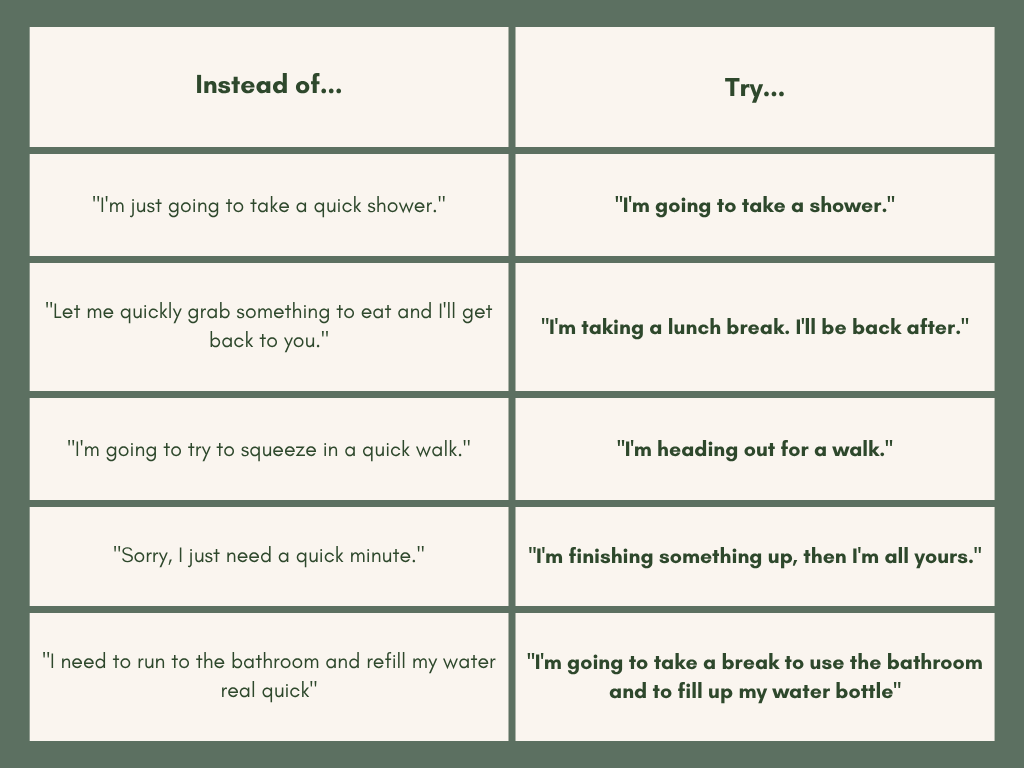
Not everything needs an explanation. Not everything needs an apology. And not everything needs to be framed as taking the least time possible.
Of course, some seasons truly require speed. Your toddler needs you. The deadline is real. You're running late. And sometimes a quick shower really is just a quick shower.
The goal isn't to eliminate urgency. It's to stop manufacturing it where it doesn't belong.
Try this: one week without unnecessary urgency
For the next seven days, notice how often your language shrinks your time. Listen for:
→ "Real quick"
→ "Just a second"
→ "I'll be right back"
→ "Let me squeeze this in"
→ "I don't have time"
→ "I'll hurry"
Then get curious. Is there an actual deadline? Is someone truly waiting on me? Or is this an old, familiar feeling that I should always be moving faster?
When the urgency isn't needed, let it go. Then take it one step further.
1. Let your words match the pace you want
Skip the "quickly." Just say what you're doing. Give yourself the time the task actually takes.
2. Notice what shows up in your body
Do your shoulders tighten when you choose not to hurry? Does a full lunch break bring up guilt? Does walking at a relaxed pace feel like falling behind?
No judgment. Just notice.
3. Practice slowness in the mundane moments
→ Walk to your car without rushing
→ Make breakfast without planning your next five tasks
→ Shower like it isn't a race
→ Put your phone down and actually taste your meal
These ordinary moments are where presence gets practiced.
4. Remember: your needs aren't interruptions
You don't have to earn your lunch break. You don't have to make your walk productive. You don't have to rush your shower in case someone needs you. You don't have to apologize for taking a few minutes for yourself.
You are allowed to take up time
The more I sit with this, the clearer it gets. This was never really about two words.
It's about a belief I've carried for years without noticing:
That I should always be moving faster. That there's never quite enough time. That my needs should fit into whatever space is left over. That slowing down means I'm not doing enough.
But not every moment of your life needs to be optimized.
Not every activity needs a purpose. Not every minute needs to be accounted for. Not everything deserves urgency.
As a functional dietitian, I spend my days helping women understand how their nervous system, hormones, digestion, and metabolism connect. Nutrition, targeted supplements, and circadian rhythm support all matter.
But so does the way you move through your days.
The pressure you create without realizing it. The needs you quietly override. The rushing you no longer even notice.
Supporting a healthier stress response isn't about adding more nervous system exercises to an already full to-do list. Sometimes it starts with questioning the urgency you carry into ordinary moments.
So the next time you hear yourself say "real quick," pause and ask:
Do I actually need to be quick?
Or can I simply let myself do the thing?
Without rushing. Without apologizing. Without treating my own time like an inconvenience.
You are allowed to take your time.
If your body has been carrying this urgency for a while, and you're seeing it in your digestion, your cycle, your blood sugar, or your energy, you don't have to untangle it alone. We'd love to help you find your rhythm again. Learn about working with our team →