
Low Ferritin Despite Taking Iron? Why Iron Absorption + Regulation Matter
Taking Iron Isn’t the Same as Absorbing It: What Your Iron Labs Are Really Telling You
One of the most common iron patterns we see in our practice is this:
A woman has been taking iron for months - sometimes even years - and her ferritin is still low.
She was told:
“Your iron is low. Take an iron supplement.”
So she does.
But her energy is still low. Her hair is still shedding. Her ferritin barely moves. Her gut symptoms got worse.
Or maybe her ferritin is low, but her serum iron and iron saturation are actually high.
Or her ferritin looks completely normal, yet other markers suggest iron isn't actually getting where it needs to go.
This is where iron becomes much more nuanced than:
Low iron = take more iron.
Because there is a big difference between taking iron and actually being able to absorb, transport, store, recycle and use it appropriately.
If one of those steps isn't working well, simply adding more iron may not solve the problem (and could actually make symptoms worse in some cases!)
Sometimes it can even distract us from the bigger question:
Why is your iron low – or poorly regulated – in the first place?
Why iron matters for women
Iron is best known for its role in hemoglobin and oxygen transport, but that is only part of the story.
Iron also plays a role in:
cellular energy production
mitochondrial function
thyroid hormone production
brain function and neurotransmitter production
muscle function and exercise capacity
immune function
healthy red blood cell production
reproductive health
pregnancy and fetal development
This is why low iron can show up as much more than simply “anemia.”
Women with depleted iron stores may experience:
fatigue
poor exercise tolerance
brain fog
headaches
dizziness
feeling cold
restless legs
hair shedding
weakness
heart palpitations
shortness of breath with even low amounts of physical activity
These symptoms can show up before hemoglobin ever becomes abnormal (hemoglobin is often used as an indirect marker for assessing iron).
Iron deficiency develops in stages. Iron stores can start declining first while hemoglobin, hematocrit and other red blood cell markers remain normal. Only as iron deficiency progresses and becomes more severe do we begin to see more obvious changes on a CBC.
This means:
You do not have to be anemic to have iron deficiency!
This distinction is becoming more clearly reflected in current guidelines. In 2026, the American Society of Hematology recommended a ferritin threshold of 30 ng/mL or lower for diagnosing iron deficiency in adults and menstruating or pregnant individuals, rather than relying on the much lower cutoffs historically used by many laboratories. In higher-risk groups – including people with heavy menstrual bleeding – a threshold of 50 ng/mL or lower may be appropriate. American Society of Hematology
A CBC is not an iron panel
This is one of the biggest misconceptions around iron.
You may be told your “iron looks fine” because your hemoglobin is normal.
But hemoglobin is not the same thing as iron stores and in my professional opinion - it is absolutely not okay to draw conclusions about iron from a CBC alone.
A CBC tells us important information about your red blood cells, including:
hemoglobin
hematocrit
RBC count
MCV
MCH
MCHC
RDW
These markers can help us identify anemia and provide clues about what may be driving it.
But they do not tell us the full story about iron status.
Your body works hard to maintain red blood cell production. That means you can gradually draw down your iron reserves while hemoglobin stays normal.
The same is true for serum iron.
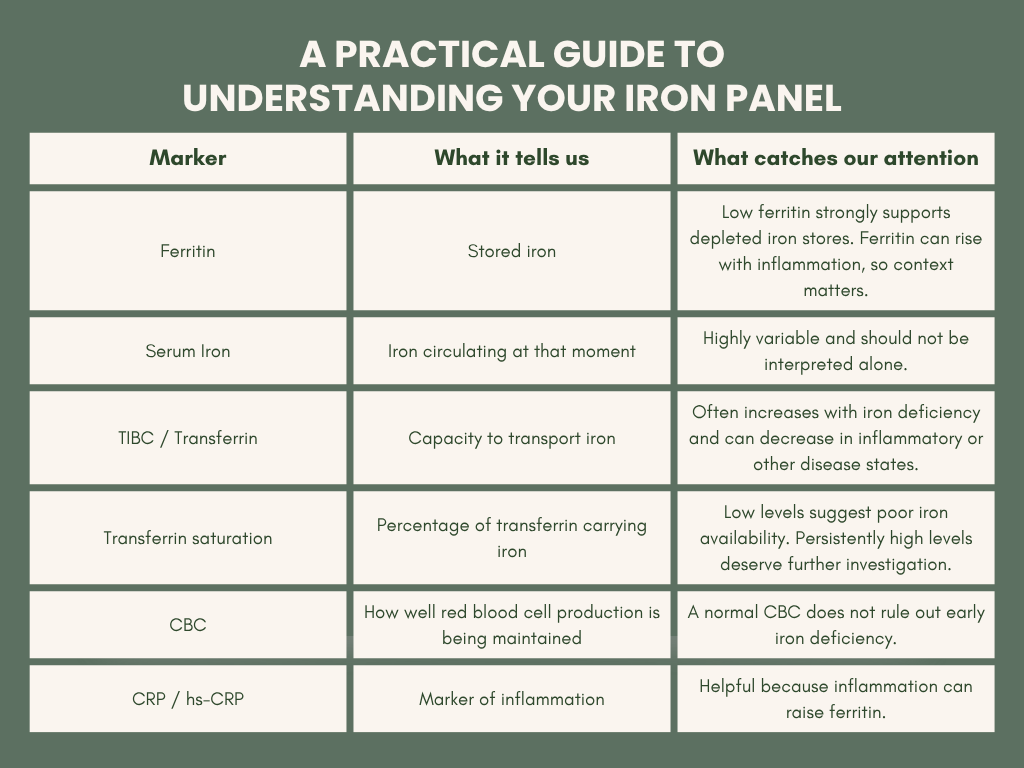
Serum iron only tells us how much iron happens to be circulating in your bloodstream at that moment. It can fluctuate with recent food intake, supplementation and other factors.
And while ferritin is incredibly useful, ferritin alone doesn't always tell the whole story either.
This is why I prefer to look at iron as a pattern rather than a single number.
The easiest way to understand an iron panel: think of a bus system
Iron labs sound complicated until you understand what each marker is actually telling you.
Here is the simplest analogy that I learned in grad school that has always stuck with me (shout out to my advanced medical nutrition therapy professor at Tufts University, Kelly Kane!).
Serum iron = the passengers currently riding the bus
This is the iron circulating in your bloodstream right now.
Because this number can fluctuate, we do not want to make decisions from serum iron alone.
Transferrin = the bus
Transferrin is the main protein responsible for transporting iron through your bloodstream.
Its job is essentially to pick up iron and move it where it needs to go.
TIBC = how many total seats are available
TIBC stands for total iron-binding capacity.
It gives us an idea of how much capacity (aka how many open seats on all the transferrin buses) your bloodstream has to bind and transport iron.
When iron stores are low, the body often increases transferrin - essentially putting more buses on the road to try to pick up any available iron.
UIBC = the empty seats
UIBC stands for unsaturated iron-binding capacity.
It reflects how much unused iron-carrying capacity is left.
Transferrin saturation = how crowded the buses are
Transferrin saturation tells us what percentage of transferrin-binding sites are currently occupied by iron.
It is calculated from serum iron and TIBC.
This is particularly useful because it gives us context around circulating iron rather than just looking at serum iron in isolation. A single passenger count doesn't mean much until you know the size of the bus!
Ferritin = the warehouse
Ferritin is our primary marker of stored iron.
When ferritin is truly low, iron stores are depleted (aka the warehouse is empty!).
But ferritin comes with one very important catch:
Ferritin also rises with inflammation.
So someone can have a ferritin that appears normal – or even high – while iron availability is actually low.
What labs should we actually look at?
If we're trying to understand possible iron deficiency, I generally want more information than a CBC alone.
A more complete assessment may include:
Iron markers
ferritin
serum iron
TIBC and/or transferrin
transferrin saturation
UIBC when available
CBC markers
hemoglobin
hematocrit
RBC count
MCV
MCH
MCHC
RDW
Additional labs when clinically appropriate
hs-CRP
B12
folate
liver enzymes
There can also be value in assessing nutrients involved in healthy red blood cell production and iron handling, including:
copper
ceruloplasmin
zinc
vitamin A
Not every woman with low ferritin needs every one of these tests.
But if someone has been supplementing iron consistently and their ferritin still isn't improving, their iron labs seem to contradict each other, or their symptoms are not lining up with basic labs – that is when we need to broaden the lens.
What is an “optimal” ferritin level?
This is where I think we need to be careful with the word optimal.
There is not one universally established ferritin level that every woman needs to achieve.
And I don't think the goal should be chasing a single “perfect” number.
But we do now have better evidence around what qualifies as iron deficiency.
The 2026 American Society of Hematology guidelines recommend:
Ferritin ≤30 ng/mL for diagnosing iron deficiency in adults and menstruating or pregnant individuals
Ferritin ≤50 ng/mL in certain higher-risk groups, including people with heavy menstrual bleeding and pregnant individuals with anemia
In adults with inflammatory conditions, ferritin below 100 ng/mL or transferrin saturation below 20% may support iron deficiency American Society of Hematology
This matters because women with ferritin in the teens or 20s have historically been told that everything looks “normal” simply because they haven't fallen below an outdated laboratory cutoff.
What I care about much more is the overall pattern:
Are iron stores adequate?
Is enough iron circulating?
Is transferrin saturation appropriate?
Are red blood cells being produced normally?
Is inflammation distorting ferritin?
Is iron accumulating excessively?
And most importantly: how does the person feel?
A transferrin saturation of 45% or higher is also a common threshold used to trigger further evaluation for possible iron overload or hereditary hemochromatosis rather than automatically adding more iron.
Why would ferritin stay low even when you're taking iron?
This is where the root-cause piece becomes incredibly important.
If you are taking iron and your ferritin isn't moving, my next question isn't automatically:
How can we give you more iron?
It's:
Why isn't the iron being absorbed or getting where it needs to go?
There are several places I would look.
1. You're continuing to lose iron
You can't fully replenish iron stores if you are losing iron faster than you can replace it.
For women, menstrual blood loss is one of the biggest reasons ferritin remains chronically low.
This can happen with:
heavy periods
long periods
fibroids
adenomyosis
uterine polyps
perimenopausal heavy bleeding
GI bleeding
Menstruation and gastrointestinal blood loss are among the most common recognized causes of iron deficiency. PubMed Central (PMC)
If you're continuously losing iron, supplementing iron is only one part of the solution.
We also need to understand why the losses are happening.
2. You're getting iron – but not absorbing enough of it
Iron has to be absorbed through the gastrointestinal tract before your body can use it.
That means gut health matters! Gut imbalances are easily one of the biggest factors we see chronically contributing to low iron - even with supplementation.
Conditions that can interfere with iron absorption include:
celiac disease
inflammatory bowel disease
H. pylori
SIBO
Low stomach acid (a super common dynamic we see with women!)
medications that reduce stomach acid
Stomach acid is particularly relevant for non-heme iron, the form of iron found primarily in plant foods.
Medications such as proton-pump inhibitors reduce stomach acidity and can reduce iron absorption, especially in people who are already iron deficient.
This does not mean every woman with low ferritin has “low stomach acid.”
It means that if someone is not responding to iron supplementation, digestive function and stomach acidity deserve consideration.
3. Inflammation may be changing how your body handles iron
One of the most overlooked parts of iron metabolism is a hormone called hepcidin.
Think of hepcidin as your body's iron gatekeeper.
When hepcidin rises, less iron is absorbed from the intestines and less stored iron is released back into circulation.
Higher hepcidin = more iron stays locked away.
Inflammation is one of the signals that increases hepcidin.
This is actually protective in the short term. Many microorganisms depend on iron, so during infection your body intentionally makes iron less available.
But chronic inflammation can create a different problem.
You can technically have iron stored in the body while still not having enough iron readily available to your tissues.
This is sometimes referred to as functional iron deficiency.
The lab pattern might look something like:
Ferritin: normal or high
Serum iron: low
Transferrin saturation: low
This is one reason ferritin should never be interpreted in isolation.
4. Iron doesn't work alone
Another piece of the iron conversation that gets overlooked is that nutrients never work in isolation - they work together.
Iron doesn't operate independently inside the body.
For example, copper helps move iron out of storage and onto its transport proteins so it can circulate and be used.
Vitamin A also plays a role in healthy iron metabolism and red blood cell production.
Other nutrients involved in healthy blood cell production include:
vitamin B12
folate
vitamin B6
riboflavin
zinc
This does not mean every case of low ferritin is caused by a hidden copper deficiency.
It means that when iron status is not improving the way we would expect, sometimes looking at the larger nutrient picture reveals another piece of the puzzle.
5. Your body recycles most of its iron
This is one of the most fascinating pieces of iron physiology that does not get talked about enough!
We often think about iron entirely in terms of:
How much am I eating?
But your body is constantly recycling iron from old red blood cells.
Red blood cells live for roughly 120 days. When they reach the end of their lifespan, specialized cells – particularly in the spleen and liver – break them down and recover much of the iron contained inside them.
That iron is then reused to make new red blood cells.
The majority of the iron needed for daily red blood cell production actually comes from this internal recycling system rather than from newly absorbed dietary iron.
This is another reason I like thinking about iron as an iron economy, not just simply an iron intake problem.
Your body is constantly:
absorbing → transporting → storing → recycling → reusing
And those systems all need to work together!
Common iron pattern #1: Low ferritin + normal hemoglobin + normal serum iron
This is probably one of the most common patterns I see.
Ferritin may be:
12, 18, 22 or 28
while:
hemoglobin looks normal
hematocrit looks normal
serum iron may still look normal
So the person is told:
“You're not anemic. Everything looks fine.”
Meanwhile she’s exhausted, losing hair, her thyroid is sluggish, and she’s struggling through workouts.
What's happening?
Your body is beginning to dip into its iron savings account.
There may still be enough circulating iron to support red blood cell production, but your reserves are becoming depleted.
This is iron deficiency without anemia.
And the next question should be:
Why are your stores being depleted?
Common reasons include:
menstrual blood loss
inadequate iron intake
increased iron needs
poor absorption (the most common driver we see)
gut issues
pregnancy or postpartum depletion
Common iron pattern #2: High ferritin + low or normal serum iron
High ferritin does not automatically mean iron overload.
Remember:
Ferritin is an iron-storage marker, but it also rises with inflammation.
Someone experiencing chronic inflammation may have:
Ferritin: normal or high
Serum iron: low
Transferrin saturation: low
Inflammation increases hepcidin, which limits how much iron is absorbed and how much stored iron is released.
This means ferritin can look reassuring while iron availability is actually poor.
This is why the broader pattern matters.
In this situation, I would want to understand:
ferritin
serum iron
TIBC or transferrin
transferrin saturation
inflammatory markers such as CRP
together rather than making a decision based on ferritin alone.
Common iron pattern #3: Low or normal ferritin + high serum iron or high transferrin saturation
This is the pattern where I would not automatically add more iron.
Example:
Ferritin: 25 (low)
Serum iron: high
Transferrin saturation: high
It is easy to focus only on the ferritin and think:
“I need more iron.”
But we also need to pay attention to the amount of iron already circulating.
Before supplementing more aggressively, I would want to ask:
Did you take an iron-containing supplement shortly before the blood draw?
Were you fasting?
Is transferrin saturation repeatedly elevated?
Are liver markers normal?
Is ferritin trending upward or downward over time?
Do you have low stomach acid or gut issues?
What do your iron cofactors like vitamin A and copper look like?
Are there other reasons iron handling may be abnormal?
One high serum iron result does not diagnose iron overload and one low ferritin alone does not diagnose iron deficiency.
Assessing a full iron panel and any other supporting labs alongside critical thinking and deeper questions is key!
Common iron pattern #4: Low serum iron + low transferrin saturation + normal or high ferritin
This pattern can look very different from classic iron deficiency.
Ferritin may appear adequate or even elevated, while circulating iron and saturation are low.
Inflammation is one possible reason.
Higher hepcidin can prevent stored iron from being released efficiently and reduce how much new iron is absorbed from the gut.
In this situation, simply increasing oral iron may not address the problem.
The bigger question becomes:
Why is iron unavailable?
That can lead us to investigate inflammation, chronic illness, gut imbalances, and other factors affecting iron handling.
What does low iron actually feel like?
Iron deficiency can affect far more than energy.
Energy + metabolism
fatigue
low stamina
feeling cold
weakness
poor workout recovery
reduced exercise tolerance
Brain + nervous system
brain fog
headaches
dizziness
difficulty concentrating
restless legs
irritability
Hair, skin + nails
increased hair shedding
brittle nails
pale skin
Cardiovascular + respiratory
heart palpitations
faster heart rate
shortness of breath with activity
These symptoms are nonspecific, which means they often get blamed on:
stress, hormones, poor sleep, thyroid issues or simply being busy.
Sometimes those things absolutely matter too.
But sometimes the ferritin of 18 sitting quietly at the bottom of the lab report deserves much more attention!
What about too much iron?
Iron is essential.
But more is not always better.
Iron is a mineral your body regulates very tightly because excess free iron can contribute to oxidative stress and tissue damage as well as feed gut infections.
Possible symptoms or findings can include:
fatigue
joint pain
abdominal discomfort
abnormal liver enzymes
glucose dysregulation
hormonal changes
But remember:
One high serum iron result does not mean you have iron overload.
Possible iron overload is evaluated using the broader picture, including transferrin saturation, ferritin, family history, liver markers and, when appropriate, genetic testing.
Food-based strategies for supporting healthy iron status
Before jumping straight to supplements, food deserves attention.
Dietary iron comes in two primary forms.
Heme iron
Found primarily in:
red meat
poultry
seafood
organ meats
Heme iron is more bioavailable and generally absorbed more efficiently.
Non-heme iron
Found in:
lentils
beans
tofu
tempeh
leafy greens
nuts
seeds
fortified grains and cereals
Non-heme iron is absolutely valuable, but its absorption is much lower.
This doesn’t mean that vegetarian diets inevitably lead to iron deficiency.
It simply means that if most of your iron is coming from plant foods, you may need to be more intentional about total intake, food pairings, and regular monitoring with labs.
Pair iron-rich foods with vitamin C
Vitamin C helps improve absorption of non-heme iron.
Simple examples include:
lentils + bell peppers
beans + tomatoes or salsa
tofu + broccoli
pumpkin seeds + berries
leafy greens + lemon
chickpeas + citrus or peppers
Sometimes the simplest nutrition strategies are the most impactful!
Be strategic with coffee, tea and calcium
Coffee and tea contain compounds that can reduce iron absorption when consumed alongside iron-rich foods or iron supplements.
Calcium can also interfere with iron absorption, particularly when taken as a supplement at the same time.
This does not mean you need to eliminate coffee, tea or calcium.
If you are actively trying to rebuild low iron stores, space them away from your iron supplement.
Important note for women that are TTC or pregnant and taking a prenatal - this is why I NEVER recommend prenatal vitamins that contain iron. Iron should always be taken separately away from a calcium containing prenatal AND dosing should also be personalized based on labs.
If you need an iron supplement, more isn't always better
Iron supplementation is another area where our understanding has evolved.
Historically, iron deficiency was often treated with high doses of iron multiple times per day.
But we now know that taking iron increases hepcidin for a period of time afterward.
That means more frequent dosing does not necessarily equal better absorption.
The American Gastroenterological Association now recommends oral iron no more than once daily, and notes that every-other-day dosing may be better tolerated for some people while achieving similar absorption.
This is especially useful for women who have struggled with:
constipation
nausea
abdominal discomfort
poor adherence because iron makes them feel terrible
What form of iron?
Ferrous sulfate remains widely used – but it’s not the best absorbed and often has GI side effects.
In practice, we often use ferrous bisglycinate which is a form of iron that is better absorbed with minimal GI side effects.
The “best” form truly depends on the individual.
What matters most is:
the amount of elemental iron
the degree of deficiency
tolerance
consistency
absorption
the underlying reason iron became low in the first place!
What if your ferritin still isn't increasing?
This is the point where I would stop simply increasing the dose.
If someone has consistently taken an appropriate iron supplement and ferritin barely moves, that is useful information.
Start asking:
Are you still losing iron?
Are you absorbing it?
Is inflammation changing the way you're handling it?
Are medications or supplements interfering with absorption?
Could there be gut imbalances or a low stomach acid dynamic at play?
Are other nutrients involved?
Was iron deficiency actually the right diagnosis in the first place?
Work with a provider who is willing to do the detective work and to ask deeper questions!
A special note about pregnancy
Pregnancy deserves its own section because iron needs and iron physiology change significantly.
During pregnancy:
blood volume expands
red blood cell mass increases
the placenta requires iron
fetal iron requirements increase
maternal iron demand rises substantially as pregnancy progresses
Pregnancy is therefore a particularly vulnerable time for iron depletion.
At the same time, pregnancy also changes ferritin, transferrin and hepcidin, which means pregnancy labs should not simply be interpreted using a generic “optimal range” chart.
The 2026 ASH guidance uses ferritin ≤30 ng/mL to diagnose iron deficiency during pregnancy, with a higher threshold of ≤50 ng/mL in pregnant individuals with anemia.
Iron needs during pregnancy should be assessed within the context of:
trimester
symptoms
hemoglobin
full iron panel
nutrients
dietary intake
Rather than automatically assuming every pregnant woman needs the same amount of supplemental iron - we should be assessing each individual and customizing recommendations to meet their needs.
The biggest takeaway: iron is not just an intake issue that resolves with a supplement
I want women to stop thinking about iron as:
Low number = take iron.
Instead, I want us asking:
Am I getting enough iron?
Am I absorbing it?
Am I continuously losing it?
Can I transport it?
Can I store it appropriately?
Can I release stored iron when I need it?
Am I recycling it efficiently?
Because the goal is not simply to push ferritin higher or to have to supplement long-term
The goal is healthy iron metabolism.
That is the difference between replacing a nutrient and actually understanding why that nutrient became depleted or poorly regulated in the first place!
Low ferritin isn't a root cause. It's a clue.
If you have been taking iron for months and your ferritin still won't move – or your iron labs seem to be telling completely different stories – simply adding more iron may not be the answer (and could actually make symptoms worse!)
The bigger opportunity is understanding why.
Inside our functional nutrition practice, we look at iron in the context of menstrual health, nutrition, digestion, inflammation, metabolic health, nutrient status and the full iron panel.
Because taking iron is one thing.
Absorbing it, regulating it and actually being able to use it is another!
Apply here to learn more about working with our team 1:1.